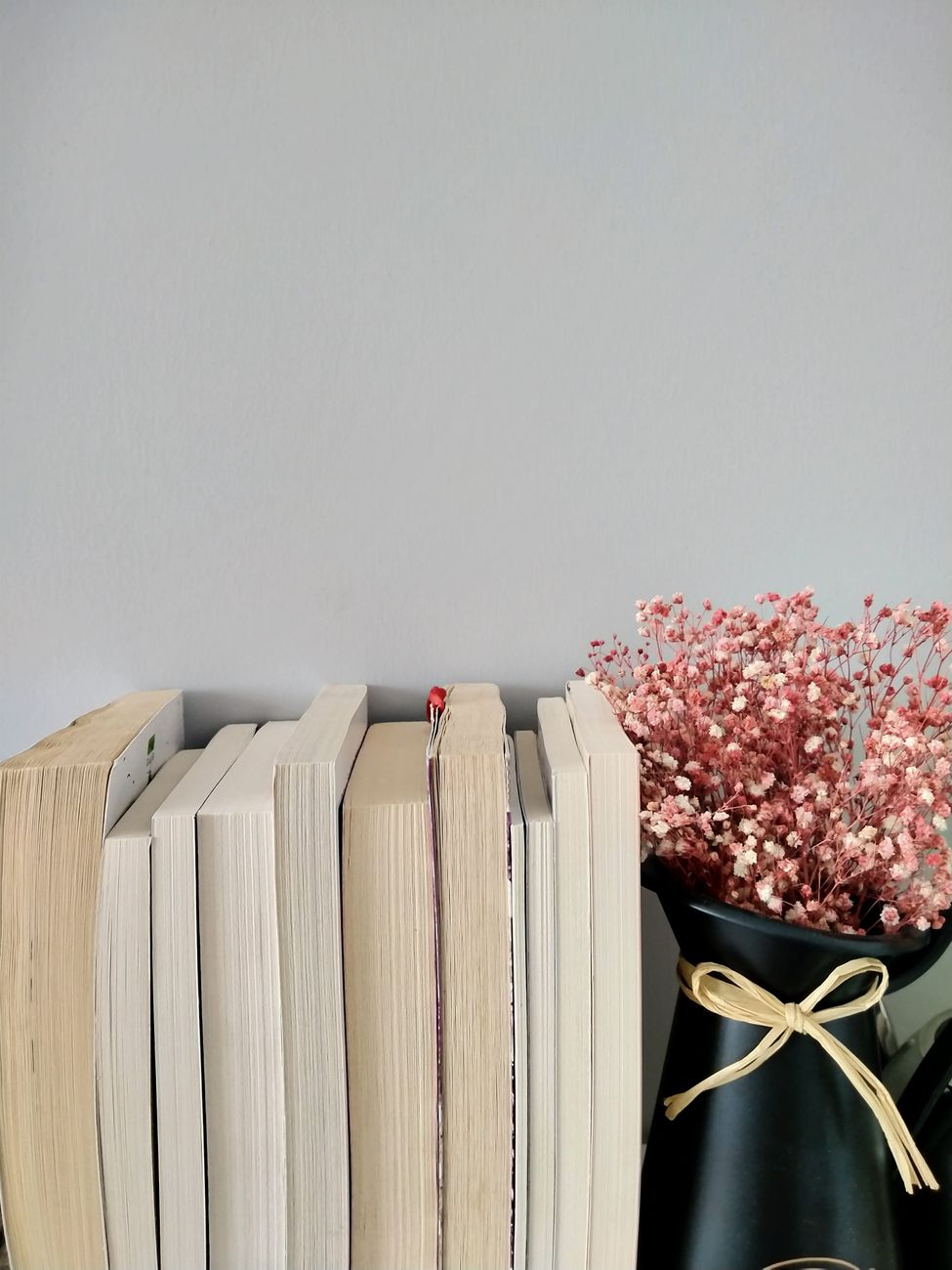
Throughout my first four months of motherhood, I have continued to read, perhaps even more than before. It is, after all, easier to read a book during nap time or while nursing at 3:00 a.m. than to enjoy most other noisy, baby-stimulating occupations. But my reading habits have changed in ways that I find worth noting.
I read more than one book at a time.
I have long been a staunch one-book reader. Occasionally, I would read a nonfiction book alongside a novel, but even this was rare. I prefer to focus wholly on one book at a time—”doing life” with it by reading before bed and at breakfast, stuffing it in my purse or gym bag, and traveling with it in the car despite knowing that any mobile reading will result in a migraine.
But now my current reads are strewn about the house so that a quality book is never out of reach. A copy of Stories Woven in Silver by Kathryn Butler and Korrie Johnson rests beside my son’s tummy time mat. Les Misérables lives beside my bed. My Romans ESV Journal waits in the diaper bag, just in case my hands are free to take notes on Sunday’s sermon. My friends at Crossway sent me a copy of Laura Story’s Stand in Awe, which waits patiently on my living room shelf.
I try to keep some burp cloths and baby toys in the main rooms in my house, never knowing when I might need them. So, too, now with my current reads.
I read in the dark.
My husband is constantly appalled at my preference for reading in dim light. I concede that it is terrible for my worsening vision, but I prefer the coziness of soft lighting. Now, I often have to read in the pitch darkness because my son has baby FOMO (fear of missing out) and refuses to eat or sleep if he can see anything at all. Thank goodness for the Kindle app!
I’ve found that the dark mode setting does not distract my son from eating or sleeping. Thankfully, there are many free or inexpensive classics available through Prime Reading. Although I infinitely prefer paper books, reading on my phone is certainly better than scrolling and has allowed me to read for several extra hours every day—and night. (I don’t know how I would have survived those frequent nighttime feedings apart from Beth Brower’s charming Emma M. Lion ebooks!)
I read more emotionally.
I do not tend to read needlessly violent books (apart from the occasional thriller like Max Brooks’ delightfully campy Devolution). However, I see now that I was far too unemotional a reader before becoming a mom. For example, although Les Misérables is by no means gratuitous, Victor Hugo describes extreme evil and suffering without softening their jagged edges. A year ago, I could have read this classic objectively, with a purely intellectual interest in its characters’ struggles. Now, I cannot compartmentalize so easily. I read a particularly sad chapter yesterday morning, and it painted a grayish tinge across my whole day.
This, I believe, is good. Painful, but good.
It was not to my credit that I formerly could read of horrific realities with cold detachment. It is “meet, right, and salutary”—to borrow the liturgical phrase—to be deeply affected by what we read. Reading was never intended to be just a thought project; it was always meant to change our hearts as well as our minds. I think this is, perhaps, why God commands his prophets to “eat” his Word (Ezek. 3:1–3; Jer. 15:16; Rev. 10:9–10). He wants Scripture to become a part of our very core—to get to our guts, as it were.
But why am I suddenly so emotionally engaged when I read? Hugo has the answer for this as well:
“The supreme symptom of love is a tenderness at times almost unbearable.” – Les Misérables, Part IV, Book VIII, Chapter I.
When we truly love, it softens us toward everything. I believe this is especially true of parental love. I can no longer read about abandoned Gavroche without a pit in my stomach. The love I have for my son makes me more prone to love all children—fictional or nonfictional.
I am eager to reread old favorites with fresh eyes.
My son is still in the high-contrast, black-and-white book phase. But this does not stop me from daydreaming about reading children’s books aloud to him once he’s a bit bigger. I can’t wait for him to enter Narnia for the first time, be sorted into a Hogwarts house (“Not Slytherin, not Slytherin!”), and join the Mysterious Benedict Society.
We are preparing to move closer to our church and, as I pack our books, I get more and more excited to set up a children’s section in our ever-expanding library. I am constantly thinking about what books I hope will become family favorites, and this excitement has spilled over into my writing as well. I am thrilled to share that I have signed a contract with Seed & Sparrow (an imprint of Baker Books) for my first children’s book! It won’t be published for quite a while, but I hope you’ll stick around to celebrate its eventual release with me. I can’t share what it’s about yet, but I’ll give you a hint: It includes Spurgeon, silly rhymes, and scriptural lessons.
I read more gratefully.
It will not surprise you in the slightest to learn that I have less uninterrupted time to read than I did previously. I have always embraced reading as a gift, and now more than ever, I gleefully gobble up words (alongside many, many snacks) whenever I have a quiet moment.
My dissertation on writers in the digital age reminded me that we live in an age of unprecedented literary superabundance. We are more literate, and there is more literature available than ever before. We are quick to forget that throughout history, learning to read and having access to books were precious privileges. Reading is not a dreary duty, done to earn a degree. It is not a performance for social media, however much we might enjoy Bookstagram or BookTok. It is not exclusive to the elite or erudite. Quality literature is available to us all, often free of charge!
Whenever I find a minute to read a page or two, I am reminded of how immensely thankful I am for books and the manifold ways in which they enrich my life—in all its various seasons.


