In Spirit-Filled Singing: Bearing Fruit as We Worship Together, I talk about how the fruit of self-control calls us to steward our bodies for the sake of physical participation in worship:
“When musicians dedicate themselves to an instrument, their physicality begins to revolve around playing that instrument (or voice, for singers). Have you noticed that musicians often develop physical habits such a stretching their fingers, beating the backs of pews like drums, or practicing chords on air guitars? Piano drills have made me an obnoxiously loud typist, violinists are branded by scars from their chin rests, and classical guitarists can be spotted by their fingernails. Musicians also tend to avoid things that might hinder their physical ability to play or sing well. Singers may trade shouting at events for herbal tea and vocal rest. I avoided sports that could hurt my fingers. A musician’s entire way of being embodied is affected by his or her vocation.
For worship musicians, developing and maintaining proper technique is crucial. Have you ever considered that warming up your voice before worship is an act of self-control? Or that practicing scales on the piano is training your hands for service? Or that building up guitar-string callouses is preparing you for lasting ministry? Self-control in ‘all things’ includes such seemingly small things (1 Cor. 9:25).
We should also consider whether there are things and activities we need to limit for the sake of our physical worship. This applies not only to leaders but to laypeople. Perhaps we need to limit caffeine before leading so our tempos don’t get out of control. Or maybe we need to stop staying up late on Saturdays so we are rested and punctual on Sundays. Maybe we need to adjust our nutrition and start exercising so we have the stamina to stand and sing more comfortably.
Paul tells Timothy, ‘While bodily training is of some value, godliness is of value in every way, as it holds promise for the present life and also for the life to come’ (1 Tim. 4:8). While the emphasis of this verse is on godliness, let’s not gloss over the fact that bodily training is of some value. It is not paramount, but it is important. Learning to use our bodies effectively is crucial to our worship and ministry ‘in this present age.’ Like athletes, we must steward our bodies to the best of our abilities so that we can endure in physical worship with ease and excellence.”1
For me, physically preparing for Sunday worship includes a good run on Saturday, a small but well-rounded breakfast, a single cup of black coffee, lots of water, a warm-up for my fingers and voice, and a banana as a pre-service snack. It’s a healthy routine and has served me well. I like to think that these healthy habits are not only preparation for but part of my worship. Eating well and exercising in particular are significant ways in which I consecrate myself—and my weekend—to the Lord’s service.
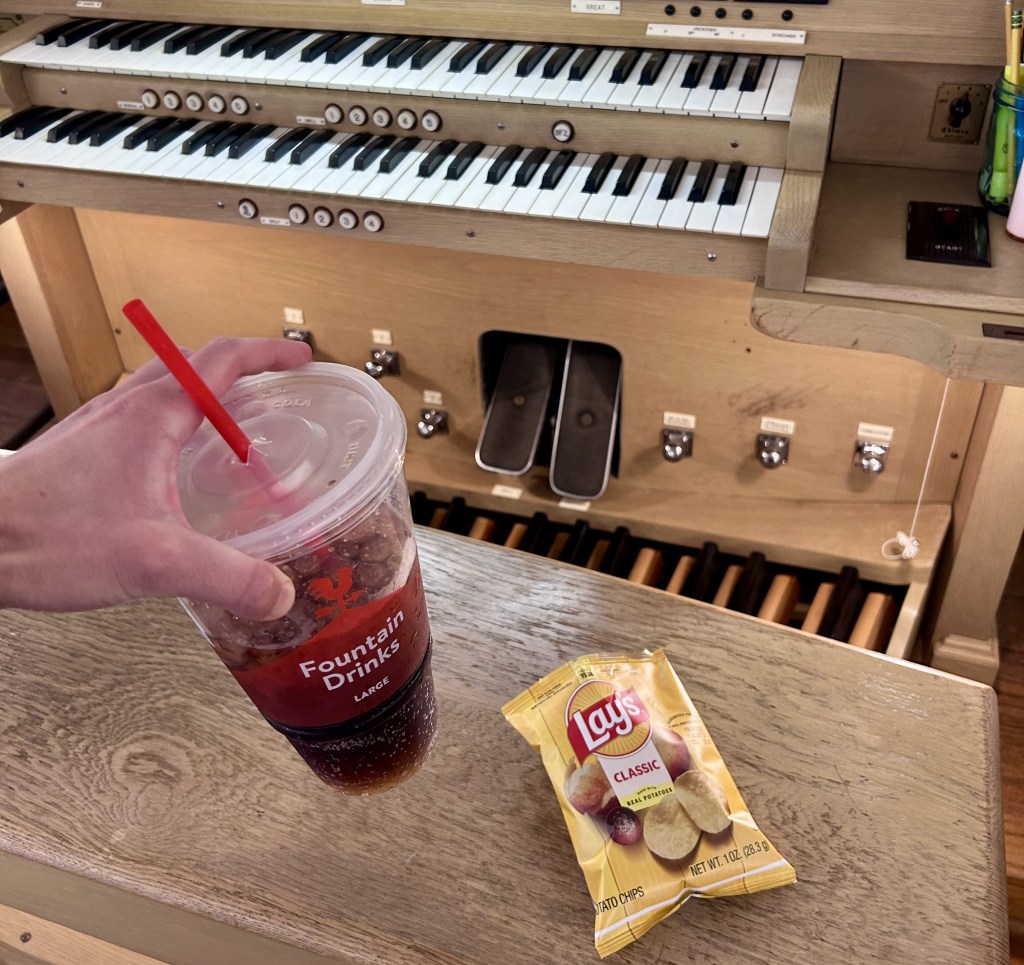
But yesterday, my worship included a 32-oz soda and two packets of potato chips—roughly, I estimated, 1,000 starchy calories.
Driving to church yesterday morning, I got the tell-tale sign of an impending migraine: I lost the center of my field of vision. I rarely get migraines first thing in the morning, so I figured it would clear up and kept driving. But just a few minutes and miles later, my vision was growing worse and the pain was starting. If you’re a migraine sufferer, you know what I’m talking about. That early inkling of pain hurts badly enough, but with its certain promise of worse pain to come, it is sheer misery.
I knew what I had to do. I pulled into a gas station, beelined for the fountain, and filled a large cup to the brim with Coke—my single sensible cup of coffee abandoned. As I gulped desperately at the soda, I tried not to think of how much sugar I was imbibing at only 7:00 a.m. and shoved aside intrusive imaginings of my teeth rotting and falling out mid-service. I reminded myself that the sugar in that Coke was essential to warding off my migraine.
Back in my car, I began to feel a bit better physically, but my morale took a downturn as I took stock of my surroundings. My usual drive to church had been transfigured and was serving as the route for the Cedar Rapids Marathon! Not only was I tempted to feel bad about consuming an enormous amount of sugary calories, I was surrounded by distance runners in peak form. It was a recipe for disaster for a girl with a history of body dysmorphia. Now, in addition to a migraine aura, all I saw when I closed my eyes was the unbelievably fit woman I saw on the street corner just before I veered into Casey’s for an oversized soda.
When I arrived at the church, my vision had returned, but the pain showed no signs of reversing its crescendo. I explained my plight to the rest of the staff and was given a few bags of potato chips from the youth group pantry—salt being another key ingredient to my migraine antidote. Once in the choir loft, I turned off as many lights as I could and donned my sunglasses. Then, I munched chips and downed Coke with pleasureless purpose. I noted how many “empty” calories were in the chips and fought a rising sense of panic.
So much sugar. So many calories. All before 8:00 a.m.
I remembered the passage from Spirit-Filled Singing that I quoted at the beginning of this post. “Aren’t you the ‘exercise so you can worship better’ writer?” I chided myself. But then I had a mild epiphany: the slurping of my soda and crunching of my chips were perhaps even more worshipful than my usual Saturday run and fiber-filled Sunday breakfast. They spoke to a determination to worship even if it cost me my sense of control over my fitness. And really, what is the point of “fitness” if we are not fit for something bigger than ourselves, as David Mathis points out in A Little Theology of Exercise?
I don’t recommend breakfasting on chips and Coke regularly, but yesterday, it was necessary for me to lead musical worship. Indeed, choosing to ignore grams of sugar and calorie counts in pursuit of a higher calling was itself, I believe, an act of worship. It was ironically good for me, body and soul.
“So, whether you eat or drink, or whatever you do, do all to the glory of God” (1 Cor. 13:31).
P.S. I am happy to report that my sight returned by the time service began, and I was able to play without significant impairment. However, to be safe, I wore my sunglasses. I have never been have never been so thankful that the organ console faces away from the congregation! Only a few volunteers saw my new look and had the good grace not to mention it until I cracked a joke myself. (Coolest organist ever? Nope, just your garden variety uncool organist with neurological issues.)
P.P.S. I do not recommend playing possibly the loudest instrument ever with an active migraine unless absolutely necessary. Perhaps I should have just gone home, but I am glad that I stuck it out.
Thank you for reading! If you enjoy my writing, consider subscribing for free. It is truly the best way for you to support my work. If this post on worship spoke to you, you might also consider ordering a copy of Spirit-Filled Singing for yourself or perhaps as a gift for your worship leader.
- Ryanne J. Molinari, Spirit-Filled Singing: Bearing Fruit as We Worship Together (Wheaton, IL: Crossway, 2025), p. 154–155. ↩︎


