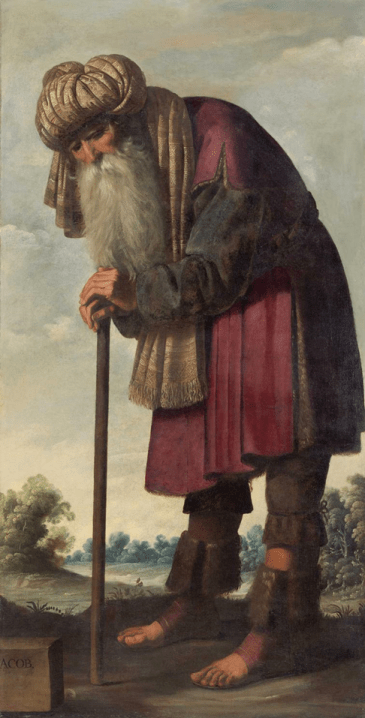
An old man. Muscles previously sinewed from hard labor and long hikes have atrophied. Hands once tanned and leathered from daily chores shiver in too-thin sheets of papery skin. His broad shoulders declare that he was once a champion wrestler. Now, slightly stooped, they denote him a determined worshiper.
He stands. Perhaps he wobbles a bit. Those around him are nervous. But he does not fall. He has his cane. It is an unwanted yet trusty companion. Leaning upon it, he clears his throat and opens his mouth.
This is a familiar scene. I could have taken it from any of a hundred church sanctuaries. But I didn’t. I found it in Scripture’s “Hall of Faith.”
“By faith Jacob, as he was dying, blessed each of the sons of Joseph and worshiped as he leaned on his staff” (Heb. 11:21, NET).
I’d never noticed this detail before. Jacob leaned on his staff as he blessed his family and praised the Lord. Essentially, he used a walker to support his worship.
A friend and choir member of mine shattered her leg last year. Her recovery had been agonizing, long and full of setbacks. While I know she longs to stand and sing unaided, she remains unflappable. Whether in a wheelchair or with a walker, she will find a way to worship.
But I’ve been in the church long enough to know that this is not so common. Whether youthful or elderly or somewhere in-between, we forget that worship is not a performance. We put on our Sunday best and discard anything that hints of weekday weaknesses. Canes and walkers are fine at home but at church? No, we must put our best foot forward—whether or not that foot is as steady as it once was.
This seems to have been Jacob’s instinct, too.
Jacob was a strong man. If you doubt this, remember that he wrestled with the Lord and succumbed only after the Lord dislocated his hip (Gen. 32:25). Afterward, he walked with a limp so pronounced it was commemorated in his descendants’ customs (Gen. 32:31–32).
Jacob’s dislodged hip was most likely painful in more ways than one. I’m sure it hurt, having dealt with severe hip pain myself in the not-so-recent past. Every step would have been excruciating and uncertain. He may never have known when his joint would hold up and when it would buckle beneath him. I suspect that his limp was also embarrassing. He was the proud patriarch of a massive family—a provider and protector. People are people, no matter the era, and to go from being strong enough to contend with the Lord to limping slowly along with frail children and livestock was surely a blow to Jacob’s self-esteem (Gen. 33:12–15).
But the Hall of Faith does not commend Jacob for wrestling the Lord in unbounded strength but worshiping Him in unashamed dependence. Charles H. Spurgeon writes that the author of Hebrews “gathered the best out of each biography; and, perhaps, the finest thing in Jacob’s life was the close of it. He was…greater in the hour of his weakness than in the day of his power.”
According to Scripture, Jacob’s greatest feat was to worship in his weakness. And, leaning upon his staff, Jacob exemplifies a deeper spiritual reality. He has been forced to lean on the Lord, to accept this difficult prerequisite for proper worship.
I rejoice when I see worshipers with walkers. I do not want them to struggle with pain or mobility issues, and, with them, I look toward the restoration of all things. But I give thanks for the way in which these believers model physically the posture we must all adopt spiritually.
One way or another, we all must give up our pretensions to self-sufficiency. I am being taught this as I trip into service with a car seat tipping me sideways. I have never needed so much help (and grace) from those around me as I do now with my infant son in tow. But my singing, although softer, is sweeter for it. I am coming to terms with the fact that, to truly worship, I must stop flaunting my strengths and begin boasting in my weakness (2 Cor. 12:9).
Like Jacob, we all must die to stubborn independence and learn to lean.
Note: The painting featured at the top of this post is “Jacob Bowed Down” by Spanish artist Fransisco de Zurbarán (1598-1664). To learn more, visit Artway.eu.


 Ryanne Molinari