Digital promotion is nearly non-negotiable for authors today. Unless you happen to be a professor or pastor with a built-in institutional readership, you are going to have to invest in your online platform to attract publishers, reach readers, and, ultimately, sell books. Before you cringe at this reality, let’s remember that building an online platform is not necessarily about promoting yourself and gaining millions of followers. Instead, it is about using the most ubiquitous communication medium of our day—the internet and social media—to connect your writing with readers who will benefit from it. (I wrote my D.Min. dissertation on Christian authors navigating digital promotion. Perhaps we can consider this the first in a loose series on the topic.)
A few days ago, Tim Challies posted an article titled “How Scammers are Targeting Christian Authors,” detailing how authors frequently receive largely AI-composed emails asking to “feature” their books. These emails are sometimes convincing, but most often are obviously written by a bot. I receive these scam emails often, and find them infuriating. They are predatory, aiming to extort authors who simply want their work to be read, which, in my opinion, is not a bad desire. Writing is about communicating; without readers, it is “stillborn,” to borrow a term from Madeleine L’Engle.
I was glad to see someone finally talking publicly about these scam emails. Tim’s article won’t stop scammers from weaseling their way into our inboxes, but it was cathartic to commiserate with other writers.
As an aside, how dumb does a scam artist have to be to think that vocational writers won’t recognize bot-written slop? Even the most convincing of these emails reads with all the intelligence and specificity of unmarked cardboard. It is always so obvious that the AI prompt was something like “write an email about how much I loved [insert book here] using the Amazon description.”
But these scams are hardly limited to email. Like some pixelated pox, they’ve spread all over Instagram. Bookstagram is infected and unlikely, I fear, to ever fully clear this virus.
I deal with what I call BookstaScam accounts on a daily basis, both as a book reviewer and an author. Here is an example of a comment on one of my recent posts:
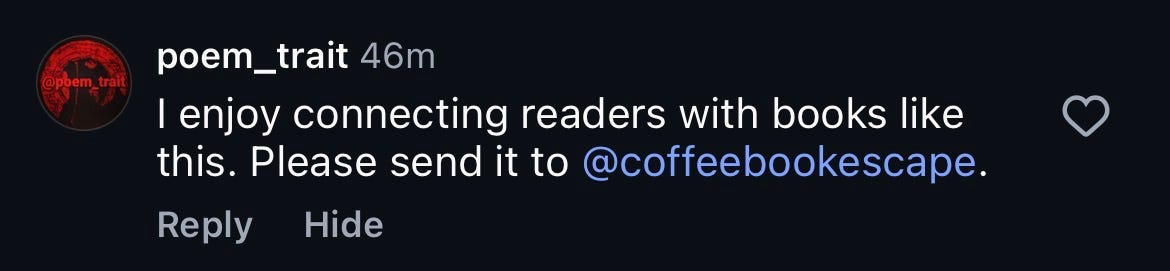
When you click the handles of these comments, either for the one posting or the page they are promoting, you’ll usually find profiles that are the digital equivalent to three kids in a trench coat. (“Of course we are a real adult human being! What do you mean this looks suspicious?”) The profiles may have photos of a real person, but they’re always slightly off. And the “Bookstagram” page they recommend? Usually it’s a hodgepodge of self-published sludge at best and AI-generated smut at worst. (Please don’t read this as a slight against self-published books; there are many excellent indie authors who, thankfully, are not falling for these scams.)
When I scroll through the books promoted by these accounts, it is so blatantly clear that they have not given my book a second’s thought. And yet, they have the audacity to be shocked that I don’t think they’re the right fit to promote my book on the fruit of the Spirit! And that I doubt they’ve ever heard of the books I recommend, much less read enough about them to promote them with integrity!
It’s obvious that these accounts, which may or may not have a real person behind them, are programmed to prey on anyone who uses hashtags relating to books, book reviews, or writing. If you play along and ask about collaborating, it’s inevitable that they will ask you to pay them to post about your book. Let’s be clear: anytime a publisher or reviewer wants you to pay them, run for your life. It’s almost certainly a scam taking advantage of your desire to be published or, if already published, promoted.
So what do we do?
BookstaScam is like Covid. It’s just something we have to live with now, managing as best we can without really eradicating it. I doubt it will be long before these scams spread to other realms, even the seemingly sacred space that is Substack! But we can combat them, at least a bit, through the following:
- Hiding BookstaScam comments immediately.
- Refusing to fall for their offer of “collaborations.”
- Blocking BookstaScam accounts.
- Checking who we follow to ensure we are not unintentionally supporting any of these accounts.
- Warning other authors and aspiring authors.
- Continuing to share quality books and support human authors on our pages, perpetuating all that is genuinely good about Bookstagram despite its digital disease.
That’s it. That’s all we can feasibly do. We cannot really report these accounts because they are not doing anything illegal. But we can dismiss them and refuse to give them any foothold for further extortion or fodder for their predatory posts.


