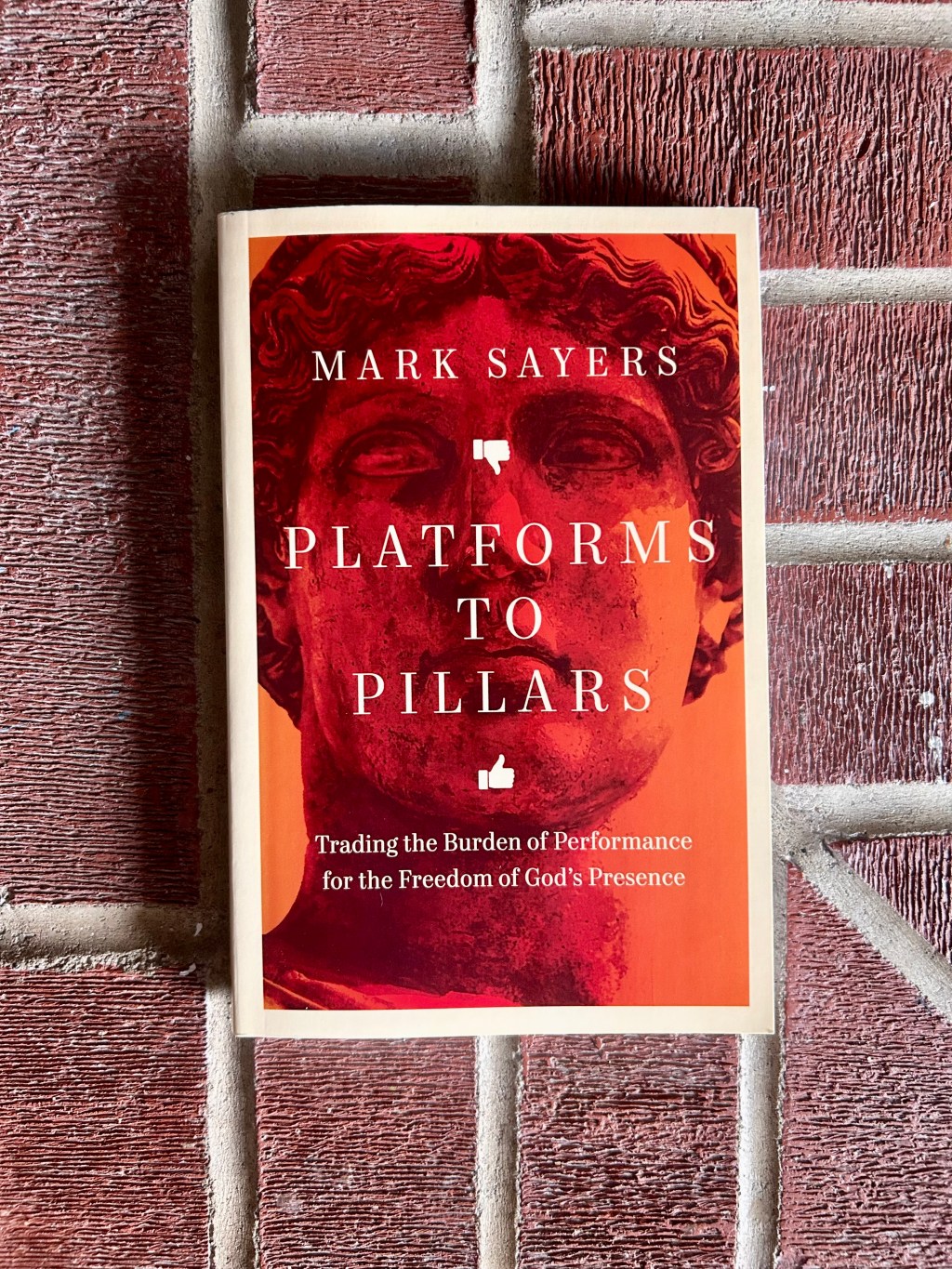
I’m in the thick of researching platforms—digital and otherwise. As I do so, it is important to me to frame my research according to a biblical worldview. I do not just want to understand the operating systems behind digital platforms and the motivations behind personal platform building. Rather, I want to understand how platforms can be used and built in a God-honoring manner. Mark Sayers’s new book, Platforms to Pillars: Trading the Burden of Performance for the Freedom of God’s Presence, released at the perfect time! This book offers a biblical response to living in a platform-centered society. It is filled with historical information that provides insight into our modern struggles, as well as biblical wisdom to help Christians live as pillars rather than platforms—building up God’s temple of praise instead of exalting themselves.
About
Platforms to Pillars is a brilliant concept for a book. In it, Australian pastor Mark Sayers examines contemporary society as a “platform society,” explaining how individualism contributed to the digital platforms that now mediate and shape our lives. Rather than simply attacking digital platforms, Sayers makes the profound observation that platforms are nothing new. Moreover, the human impulse to build platforms is an ancient temptation.
The first part of Platforms to Pillars compares the concept of platforms with that of pillars, establishing the goal of the book as a whole: to help readers understand the types of platforms at play throughout history and the contemporary era, and to move from building platforms to living as pillars. Platforms exalt the self over and above others, but lead to anxiety, disconnection, and diminished well-being. By contrast, pillars are faithful men and women who give themselves to building up others and living in service to God. This life of humility leads to greater satisfaction and fruitfulness. Sayers presents Tim Keller as an example of such a pillar, which is very helpful. After all, Tim Keller was unafraid to use digital platforms in service to his Lord. That said, digital platforms are not the issue: rather, we must look at the heart behind how we use them.
Having established our two options—build platforms to serve ourselves or live as pillars to serve the Lord—Sayers considers different types of platforms throughout history. This is where his idea really shines. He identifies historical platforms such as the royal dais, the performance stage, and religious high places such as mountains. He describes how each of these platforms exists today in digitized forms. Due to the democratization wrought by digital platforms, we can all attempt to live as royals, actors, and godlike beings. But rather than bringing us greater freedom and enjoyment, we succumb to the same paranoia as Pharaoh in Exodus. We live in fear of being canceled, losing our relevance, or watching our follower count shrink. We worry about being seen for who we really are—not just who we appear to be online. In the digital age, everyone can climb up onto a platform—but at what cost?
I appreciated that Mark Sayers did not simply decry the manifold dangers of these new platforms, though he did include them where helpful. Instead, he focuses on the state of the human heart—which has been the same since the Fall. The same temptation that led early man to construct the Tower of Babel informs our restless platform-building today: to make a name for ourselves and to live independently of God. Digital technologies are new, but mankind’s desire for self-exaltation certainly is not.
Review
I benefited from this book’s wisdom, though I admit that it felt rather scattered. I would have preferred more focused sections. For example, individualism is a key factor in any discussion of digital platforms. However, I felt like a single, comprehensive chapter on individualism would have been more helpful than the bits and pieces strewn throughout, even though these were well-researched and interesting.
I also did not think the large section devoted to what Sayers calls “the Exodus pattern” was particularly helpful. I can see what he was going for, but it either needed more development to ensure that it was clearly relevant or it needed to be its own separate book. I recommend skimming that section if your primary interest is in digital platforms.
Finally, I would have appreciated a more detailed consideration of pillars. A great deal of space was devoted to historical and contemporary platforms, but the idea of pillars was not treated with equal length or depth. Still, I understood the premise in general and found it helpful.
Recommendation & Purchase Information
Platforms to Pillars is written for Christians who want to live with greater discernment in our “platform society.” While this book does not offer specific applications such as what sort of content to produce or which platforms to avoid, it offers something better: a powerful reminder that digital issues are spiritual issues, and that the temptations of platforms (whether digital or literal) ultimately stem from our wayward hearts.
This book could be read by all adult readers, but it is a bit denser than some other books in the same field. For example, I found Samuel James’s Digital Liturgies is equally rich but more accessible and immediately pragmatic. “Key Idea” sections throughout Pillars to Platforms will help readers of varying ability to stay engaged, so please do not be deterred from giving this book a read or listen if it sounds interesting to you.
Platforms to Pillars can be purchased directly from Moody Publishers, from ChristianBook.com, or on Amazon. It is also available as an ebook and audiobook.
Note: I received a copy of Platforms to Pillars from Moody Publishers in exchange for an honest review.
Thank you for reading! If you enjoy my work, consider becoming a free subscriber using the box below:
You might also consider pre-ordering my book, Spirit-Filled Singing, which releases on November 4th.


 Ryanne Molinari
One response to “Platforms to Pillars: Trading the Burden of Performance for the Freedom of God’s Presence”
[…] Platforms to Pillars: Trading the Burden of Performance for the Freedom of God’s Presence […]
LikeLike