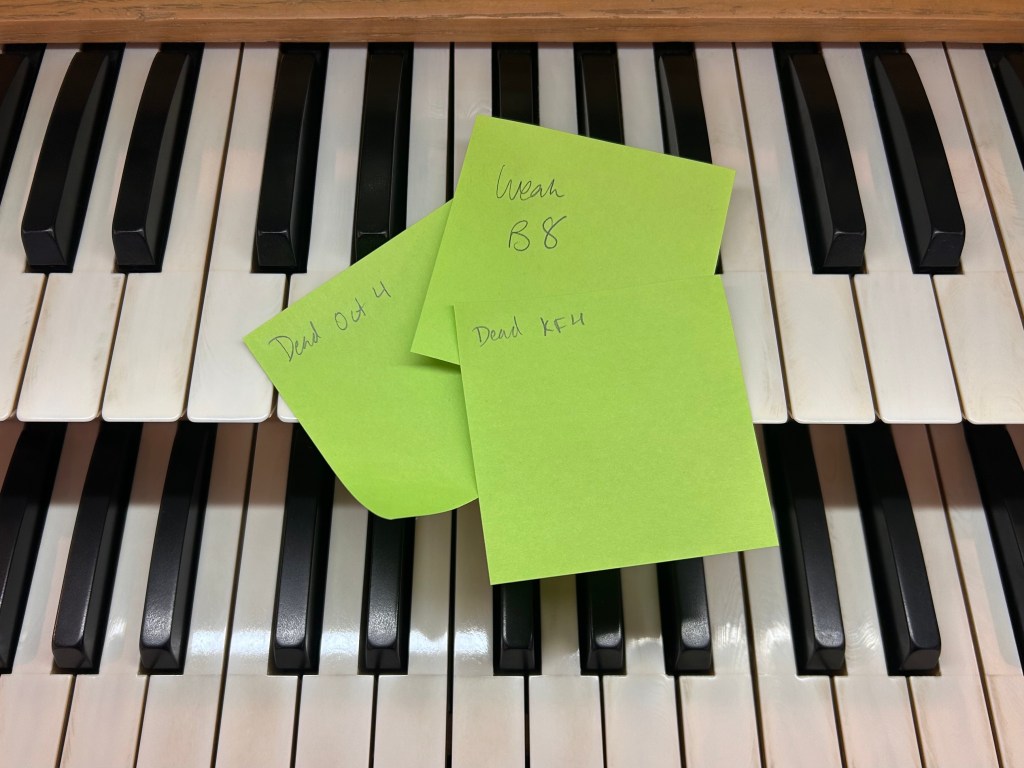
Pipe organs are temperamental instruments. True to their name, they seem to live—and die—like biological beasts. They fluctuate with humidity and temperature. The smallest bits of dust can set them wheezing. Occasionally they refuse to play—or to stop playing—for no clear reason, and never when convenient.
Knowing that a freshly-tuned organ awaited me, I was more excited than usual to practice this week. But barely five minutes into my practice session, I stumbled upon a dead note.
And another.
And then one that seems to be on its last legs.
I called the tuner, who was as baffled as I was, and I trust we will sort out the issue when he is back in town. But that did little to alleviate my annoyance as I sacrificed the time I’d hoped to spend rehearsing difficult repertoire to, instead, rearranging my registrations to avoid the dead pipes.
Fortunately, my twin vocations provided balance and perspective, as my frustrations in music produced fodder for writing. As I fiddled with the unresponsive stop (basically, the tab/pull that triggers a pipe to play), I heard no sound. But I caught an echo, I believe, of God’s heart.
Is this how my Lord feels when I refuse to sing? Or serve? Or pray? Am I like a stuck pipe in an instrument he has lovingly built and tuned and is eager to play?
Scripture describes the church physiologically as a body made up of many members (Rom. 12:4–5; 1 Cor. 12:12–20). I also like to think about the church musically. Like an expert organ builder, God fits many different pipes into one instrument—the church—and sets them singing with the wind of his Spirit (Eph. 5:18–21).

When I climb back into an organ’s chamber, I am always struck by the number and diversity of its pipes (see above). There are building-rattling reed pipes, sturdy cylindrical foundation pipes, and tiny, needle-like pipes for the highest pitches. There are pipes that imitate trumpets, strings, and flutes—even, on some organs, pipes that sound akin to the human voice.
And yet, each of these pipes has the same basic construction and mission. They are each built to channel wind from the organ’s bellows and to lend their unique pitch and timbre to a worshipful chorus. And when one pipe dies, the entire instrument suffers. The organist must then figure out how to produce the same music without all the necessary players.
As an aside, I often think it takes more skill—or at least, a distinct type of skill—to play a faulty organ than a flawless one. Praise God, then, as the Greatest of Organists! He continues to build his church and advance his kingdom through a continually “under maintenance” instrument.
But back to the dead pipe. As frustrated as I am with that unresponsive note, I relate to it. A single F# from a rank of flutes, it’s not a powerful or prominent pipe, but it adds a clear and bright tone when playing its part. I did not realize until this week how much I rely on it. It is not as bombastic as the trumpet nor as foundational (pun intended) as the principle. But I use it in every service and, right now, its absence is more noticeable than its presence. I am eager for it to sing again, and to lend its sweet little voice to worship. The gap where this note should be pains my ears and heart.
Once more, I wonder: is this how the Lord feels when one of his church’s members stops showing up? Or stays silent instead of singing? Or begins to think that, just because his voice is small, it does not matter? Or, because her service is often unnoticed, it is not important?
We are prone to be stubborn people—stuck pipes. But may we be content to play whatever part God has assigned to us, to let him work in and through us by the Spirit as we joyfully join ranks with saints whose gifts and roles differ from ours. Like organ pipes, we have little say in how we are designed and where we are placed. But we can serve and sing wholeheartedly, no matter how “small” we might feel.
As for me, I want to be the best little flute pipe I can possibly be.
Thank you for reading! If you enjoy my writing, consider subscribing for free using the box below. It is the simplest way to support my work:
You might also be interested in my book, Spirit-Filled Singing: Bearing Fruit as We Worship Together, which explores the biblical heart behind congregational singing. You can order it using the link below or directly from Crossway.
Finally, if you enjoy music (and I hope you do!), you might also enjoy following my on Instagram, where I regularly share hymn challenges and other musical content. You can check out my most recent posts below:


2 responses to “Stopped Pipes & Stubborn People”
[…] Stopped Pipes & Stubborn People […]
LikeLike
[…] Stopped Pipes & Stubborn People […]
LikeLike