It’s Advent, a season of special services and rousing carols. Even people who rarely listen to traditional worship music will find themselves humming along to “What Child is This?” or belting out “Glo-o-o-o-o-oooo-o-o-o-o-ooooo-o-o-o-o-ooo-ria!” when “Angels We Have Heard on High” plays.
For contemporary and traditional worship leaders, the pressure is on. It may be a season of waiting for everyone else, but for us, it tends to be a season of frantic rehearsing.
Sometimes, after special services such as Christmas Eve, I’ll find myself disappointed. Maybe I hit a wrong note in the prelude or didn’t use the exact registration I planned for one of the carols. Maybe I played the postlude too fast or my piano solo didn’t testify to my hours of practice.
Earlier this autumn, though, I was struck with a thought both comforting and convicting: I’m using the wrong metric.
The Backstory
I direct worship at a Lutheran church, so Reformation Sunday is a big deal. I was particularly pleased with my music selections this year, which included a choral motet and two contrasting versions of “A Mighty Fortress” for my prelude and postlude. (In hindsight, this is probably what other denominations think Lutheran worship is like: endless variations of “A Mighty Fortress.”)
As usual after service, I dashed across town to attend the church where my husband is a pastor and I am a member. Taking my place next to him, he asked the same question he asks every week: “How did your service go?””
“Meh,” I replied.
But as I joined in the singing at our church, I considered why it was that I felt my service had been merely “meh.”
The choir did an excellent job and the congregation sang with gusto.
The service was not, in fact, “meh.” Rather, parts of my performance had been—at least, in my mind.
Because my postlude did not go exactly as I’d hoped and because I fumbled a note or two during a hymn introduction, I rejected the entire service as “meh.” I was evaluating a corporate worship service based on how I played as a soloist. While this approach leads me to practice diligently, it can err toward self-focus.
As I thought about this, I realized that I tend to spend more time practicing my solo pieces than I do the congregational hymns. Pragmatically, this is because my solos are more difficult. I’ve played most of the hymns before—multiple times. Simply from a technical perspective, I do not need to spend as many hours on these as, say, a Bach fantasia.
But while I may need to devote more practice to a challenging postlude or offertory, I should not let the perfection (or lack thereof) of these determine my view of worship in general. My job as a worship musician, after all, is to support my congregation in singing—not to impress them with my solos.
In Space and Spirit
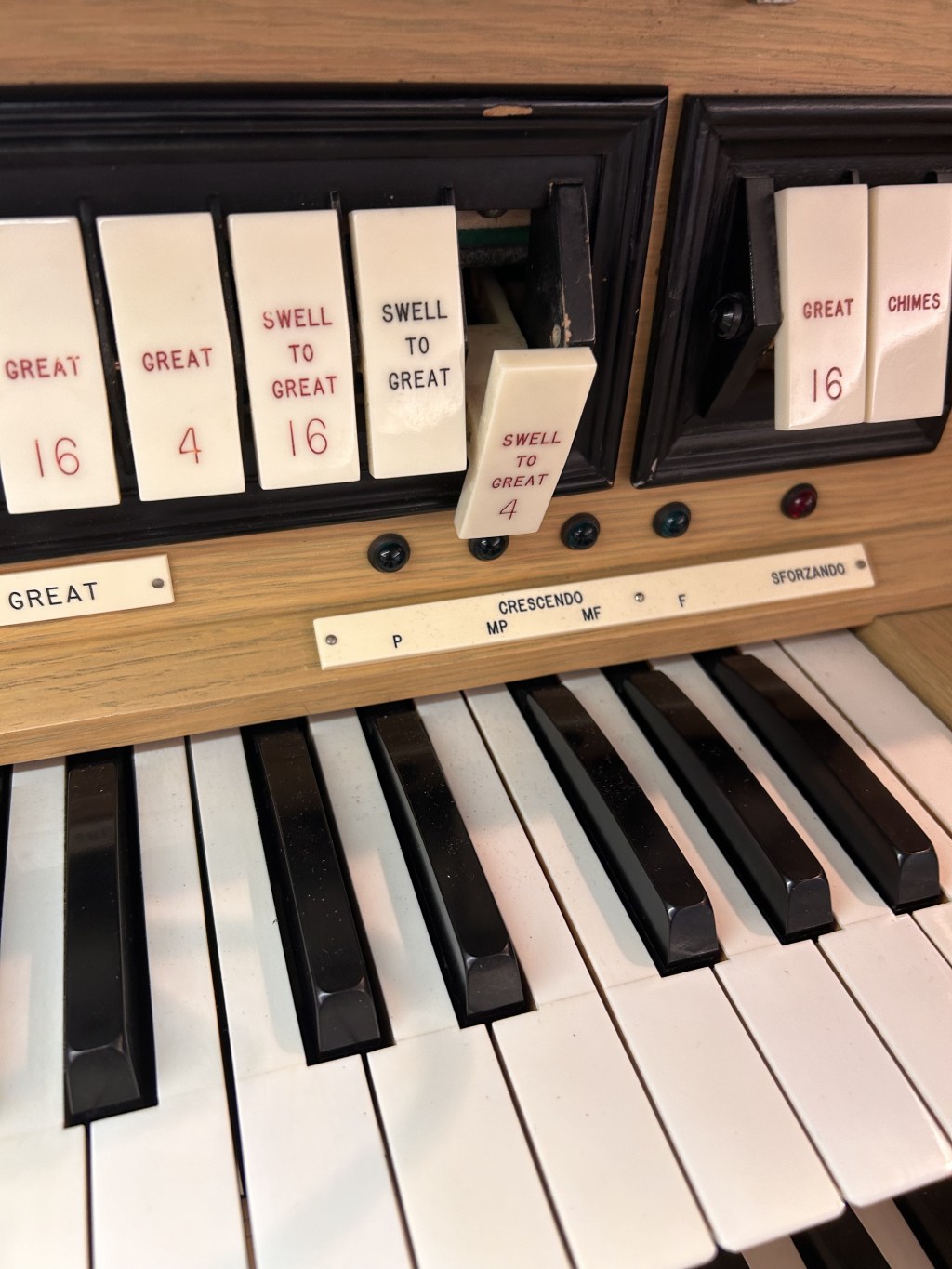
When it comes to my role and efficacy as a worship leader, it is worth taking my cue from the placement of the organ at the church where I work: at the back of the sanctuary, facing away from the congregation.
I am not the focus.
I am a leader, but not from the front. I am not meant to drag my congregation along in my wake but to offer a foundation for their participation—a support for their singing.
Spatially and spiritually, I am meant to lead from the back.
My most basic responsibility is to get out of the way.
I knew all this cognitively. This reality is a major part of why I am drawn to music ministry. I don’t want to be the center of attention. I would far rather be in the background. But it was important to be reminded that if my heart is truly to serve through music, my “metric” must reflect this.
My determination of whether or not a service “went well” should be based on the congregation’s participation: Did they sing with enthusiasm? Did they valiantly struggle through a new yet fruitful song? Did they feel supported as they picked out harmonies? If so, then that service can be counted a success, whether or not I miss a few notes in my offertory or decide last-minute to use an easier hymn introduction than the one I’d written.
A Better Metric
I once asked a non-musical friend how he would describe my job as a collaborative pianist. “You make singing less awkward,” he said without hesitation.
That’s it. That’s the goal. There will always be room for musical growth, artistic innovation, and improved leadership. (There’s a reason so many of my fellow organists are nearing ninety and still feel they have work to do!) Sometimes, though, it is necessary to go back to the basics—to take undue pressure off ourselves and turn our focus back to those we serve.
I am reminded of what pastor and author Tim Challies writes in his article The Mark of the Most Successful Worship Leaders:
“The most successful worship leaders are the ones who want to hear their congregations sing—to really sing.”
The most basic measurement of an effective worship leader—as with a competent collaborative pianist—is creating an environment and culture in which participants can sing with confidence.
This is convicting. My job must be fundamentally others-focused. If I do not rejoice in the hymn-singing of my congregation because I’m beating myself up over a “meh” solo—well, something is amiss. My heart needs a tune-up.
This new and better metric is also comforting. I need not despair if I miss a note so long as my people are not hindered in their participation. This does not liberate me from diligent preparation, but it ensures that my work is not selfish. It transposes my solitary practice hours into act of service—a joy and delight far removed from the pressures of performance.
Conclusion
As you move into Advent and Christmastide, I hope you’ll take this “metric” to heart. If you’re a worship leader, I hope it encourages you. I hope it alleviates some of the performative burden you may feel and helps restore your commitment to serving your people through song.
If you’re a participant, I hope that this encourages you to sing with greater gusto—to be unafraid of a voice crack or a mispronounced word or a new melody. As you do so, you not only worship your Lord but encourage the leaders he has given you more profoundly than you can know.
Measure your music based on this best metric: singing people, not on solo performances.


 Ryanne Molinari