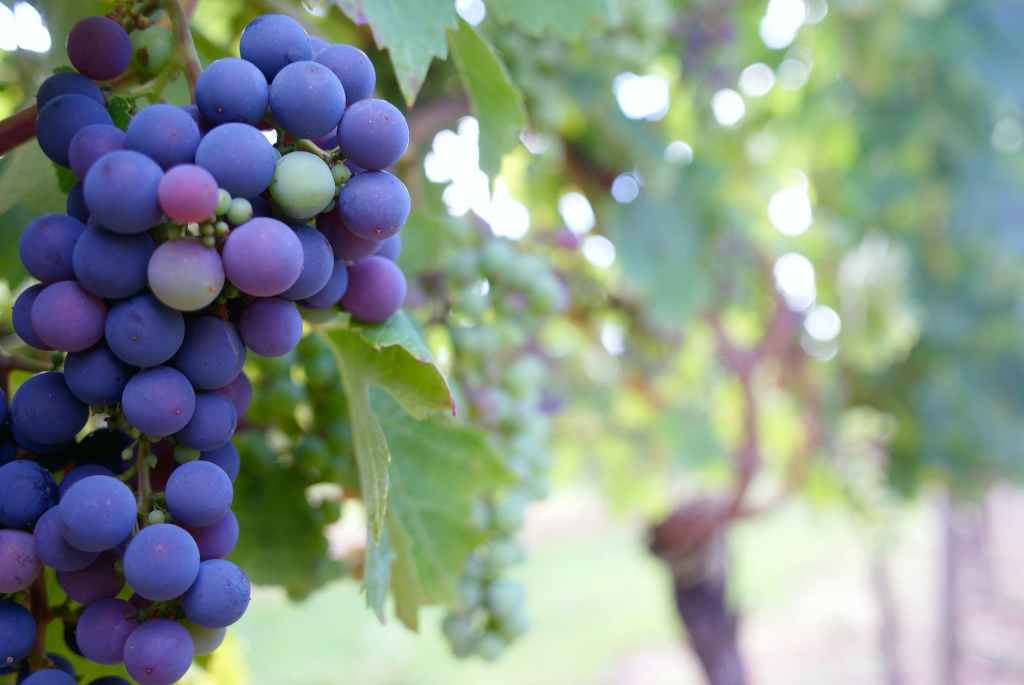
When we first moved to Iowa, we were met with tremendous fruitfulness—and not just spiritually! Upon moving into our home, we found a young apple tree, a mature cherry tree, and two lush grapevines. I was enchanted.
Having grown up in Phoenix, I was used to planting ill-fated gardens each year only to watch my seedlings wither beneath the sun’s relentless gaze. I knew well the truth of Isaiah 40:7-8 (“the grass withers, the flower fades”) but now I was seeing the simile of Psalm 1:3 (“He is like a tree planted by streams of water that yields its fruit in its season, and its leaf does not wither”). I completely understood the rocky ground of Matthew 13:5, where seeds sprang up only to wilt, but finally got to witness firsthand the beauty of Matthew 13:8 soil—deep, rich, fruitful soil.
I revel in the fruitfulness of our “bit of earth,” but as I delighted in the heavy boughs of our cherry tree and the increasing yield of our apple tree, I neglected the health of our grapevines. I was so enthralled by their greenery, it only occurred to me a week ago: were they a little too lush? Should I have pruned these?
I had no idea how to prune grapevines. Fortunately, when you’re a pastor’s wife, you always know someone who knows someone who knows how to do that thing you don’t. (How’s that for a sentence?) A generous man from church offered to teach me and I eagerly accepted.
However, after we finished pruning my vines, I was struck with sorrow. They had been so beautiful. I watched as a cardinal came looking for his lunch. He found nothing, not even shade.
Both vines had to be reduced to two main stalks with a few layered branches. The dead growth is gone, but so is much of what I thought was healthy.
And yet, our church’s resident grapevine expert (this should be an official title) assured me that this ruthless pruning is necessary. Otherwise, my vines would suffer long-term. Their fruitfulness would diminish, and their strength would fail.
As we worked together on the vines, I joked, “I know nothing about pruning, but I will theologize about it later.”
So here I am, prepared to theologize.
Five Lessons from Pruning Grapevines
Jesus describes himself as the True Vine and continually employs fruitfulness language. Almost every new skill I’ve learned from living in Iowa has had remarkable theological lessons latent within it, so—since I have no longer have grapes to press into wine—let me squeeze a few lessons from pruning…
1. Get rid of the dead stuff first.
The first things to go were the crackling grey twigs. They were obviously dead—ugly and pointless. I talked about this last year in my post “Cross Pollination”, but it’s worth restating:
…this freed my plants to start over; without the infected parts, the remaining stems began to thrive again. I know very little about pesticides and pruning, but I do know that, if we desire to be fruitful, we must eliminate all that is dead and dying within us.
Getting rid of the dead stuff seems simple, but it is physically and spiritually painful. Every time I pull weeds or break off dead flowers in my garden, I end up with scratches and hives on my arms and dirt under my fingernails. But it has to be done. We have to plunge in somehow.
2. Take time to disentangle.
The most time-consuming part of pruning was disentangling. It was not always apparent which branches were growing directly from the main stalk and which were excess. Because it was crucial not to accidentally cut the main stem, we had to follow each branch from its outermost leaves to its point of origin, carefully separating them from one another.
Disentangling takes time. Day by day, we have to discern what is part of the True Vine and what is a wayward, superfluous branch—what is drawing us closer to Christ and what is sapping our strength. Be patient as you learn and grow in Christ. Be careful not to cut yourself off from the True Vine as you work to prune away unfruitful branches.
3. Stick close to the vine.
The branches growing directly from the central vine survived our aggressive pruning. These are the branches most likely to bear fruit and remain healthy long-term because they draw their strength from the roots of the vine itself, not from other branches.
Never stop pressing into Christ. Never stop looking to him, abiding in him through prayer, study, and worship. Pruning is painful, but Christ is merciful.
4. Value fruitfulness over leafiness.
I thought I loved my grapevines, but I was wrong. I loved their sprawling branches but I failed to truly love them; I loved their appearance of fruitfulness more than the real thing.
Following Christ requires sacrifice. We may lose everything. We may stand humiliated before others like my stripped-bare grapevines. Looking at my vines still makes me sad; they seemed so glorious only a week ago, and now they are skeletal and near-bald.
But Jesus promises us that loss for his sake is gain. Our end is not to look fruitful for a season but to bear fruit for eternity (John 15:8, 16).
5. Don’t go it alone.
As I said, I knew nothing about pruning grapevines until last week and am still far from competent. Fortunately, Christians are made for community; our spiritual pruning is not a solitary endeavor. We need others to point out the dead branches we are ignoring, to help us disentangle truth from falsehood, to pull us closer to Christ when we are struggling, and to cherish our fruitfulness enough to stand by us when we are barren like my vines and when we are flourishing like riverside trees.


 Ryanne Molinari
Leave a reply to Powell Cancel reply