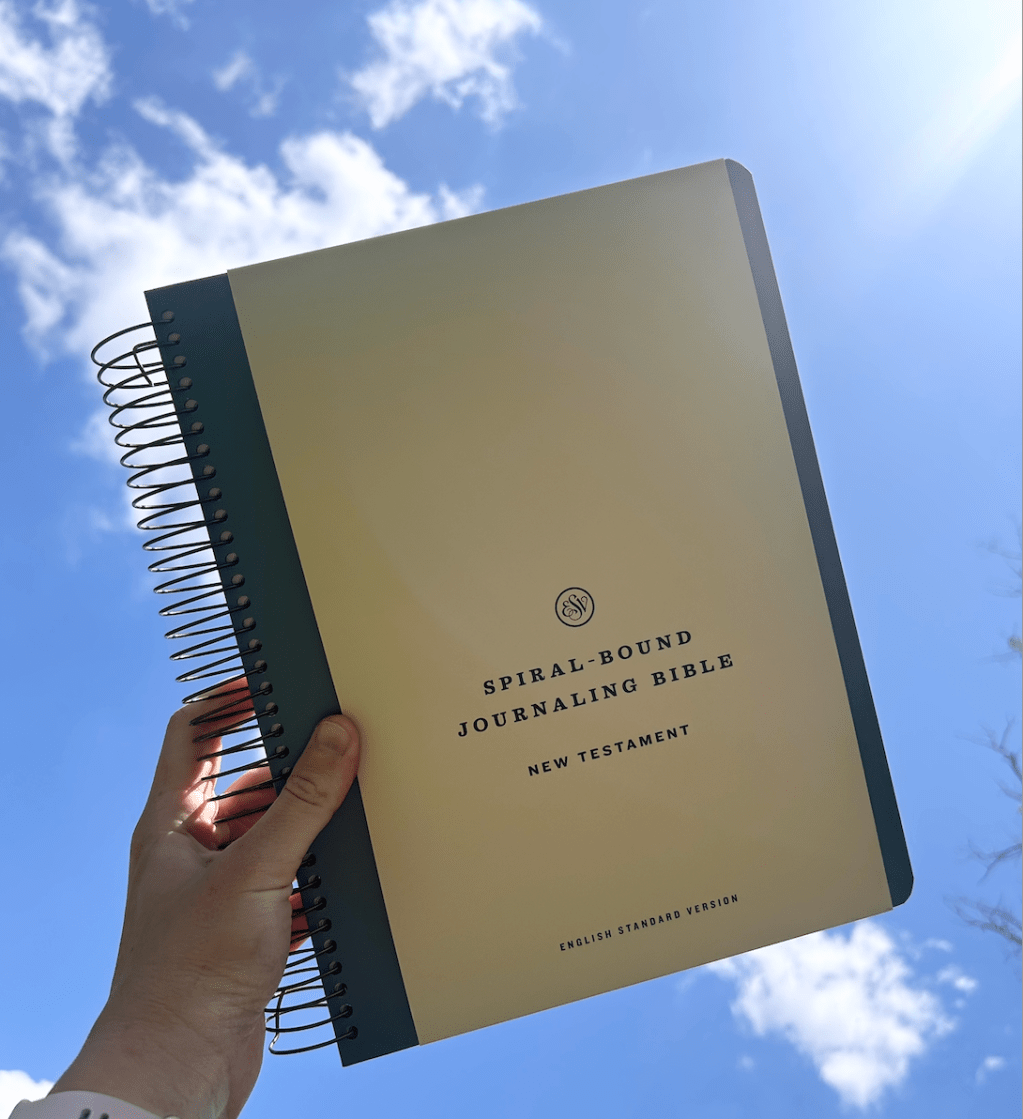
I love my ESV Study Bible, which includes a wealth of contextual information, cross references, and (my favorite) charts. Throughout 2024 and 2025, I’ve also been enjoying the ESV Chronological Bible, which has given me a better understanding of the scope of Scripture.
But as an avid annotator, I have struggled with the reality that my Study Bible has delicate pages and almost no margin space. My Chronological Bible, although it has more generous spacing, feels more like a reference Bible than a devotional one. Add to this the fact that, as much as I love annotating my books, I am also finicky about marking up my Bibles. I’ll highlight lines in Pride and Prejudice with wild abandon, analyze John Donne until his sonnets can scarcely be seen, and scribble all over my school books.
But the Bible is different—right?
To Annotate or Not to Annotate
It is right for me to approach Scripture with greater care. At the same time, I am reminded of this quote attributed to Charles H. Spurgeon:
“A Bible that’s falling apart usually belongs to someone who isn’t.”
Annotating Scripture thus poses a dilemma for me, and I’m sure I’m not alone in this. Do I treat the Bible with greater caution than other books, keeping my notes neat and minimal? Do I only annotate when I have something brilliant to say? Do I highlight only when I have no other way of remembering the passage at hand? Is keeping my inky paws off those pure pages the proper way to honor Scripture as set apart from other books?
Or, knowing that Scripture is the most important book and demands careful, thoughtful reading, should I take the opposite approach? Should I highlight and annotate with vigor—even if it mars the delicate pages or crowds the already-crowded text? Should I squeeze my questions and prayers into the margins, allowing Scripture to read me even as I read it?
To annotate or not to annotate—that is the question that has stilted my Bible study for so long. Usually I opt for copying out passages into my journal and jotting down my thoughts, prayers, and questions that way. This is an excellent practice; transcribing Scripture in our own handwriting is a transformative discipline. But there is also something to be said for writing directly alongside the printed text.
Thankfully, the folks at Crossway are well ahead of me and have come up with a simple yet elegant solution: a series of journaling Bibles that leave me with no reason not to annotate Scripture.
About the Spiral-Bound Journaling Bible
The ESV Spiral-Bound Journaling Bibles are, first of all, excellent Bibles. I love the ESV translation, which you can read more about using this link. I particularly appreciate that the translation team of over 100 scholars sought “to reproduce the precise wording of the original text and the personal style of each Bible writer.”1
The ESV Journaling Bibles are also brilliantly designed. The text is decently sized and widely spaced, encouraging strain-free reading. They are also not too big to bring to church or Bible studies (or your local coffee shop). Instead of binding the entire Bible together, Crossway divided it into five individual volumes: the Pentateuch, Historical Books, Poetry, Prophets, and the New Testament. Because I am planning to lead a women’s Bible study on Luke in the fall, I’m starting with the New Testament.
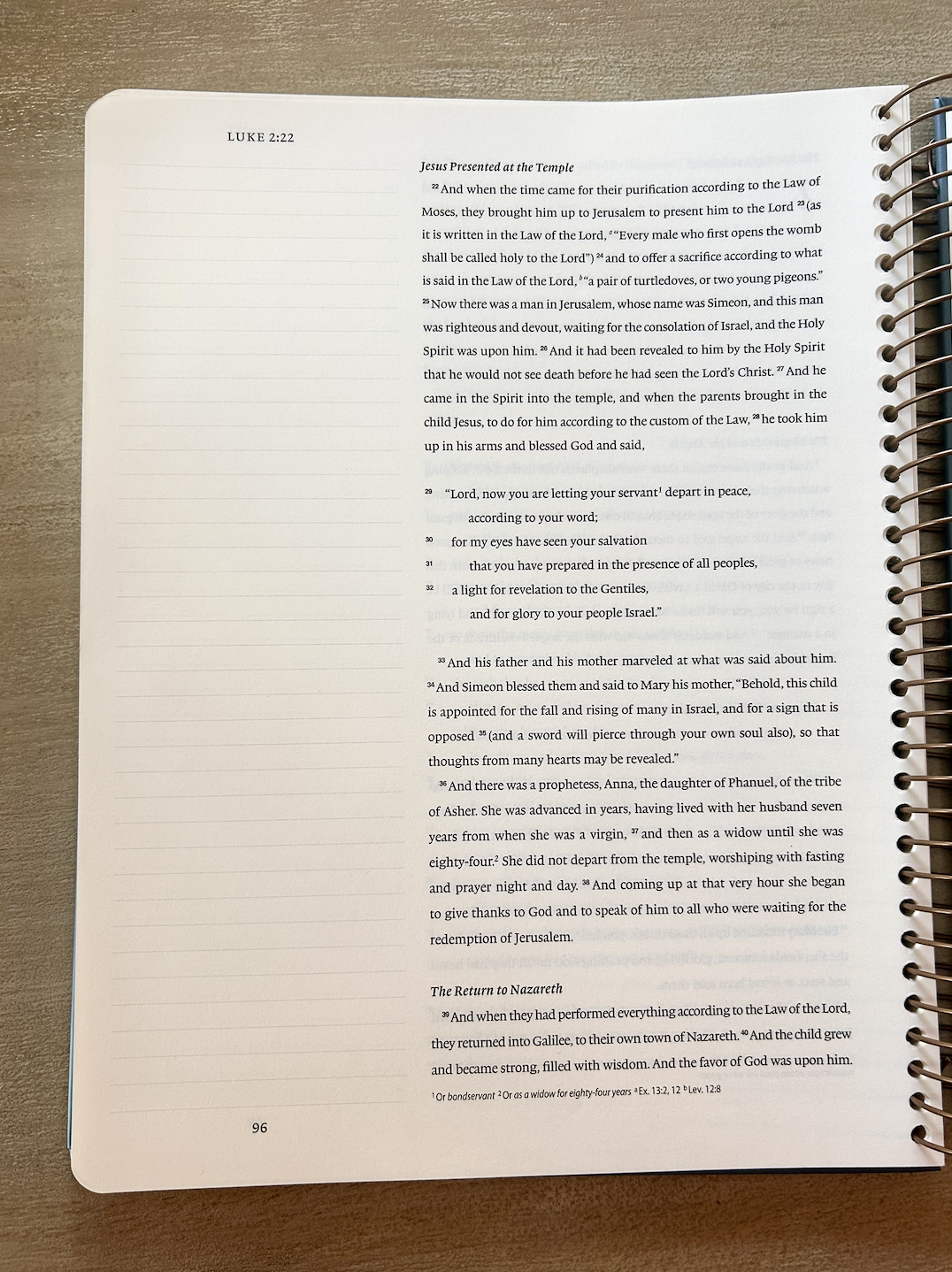
The ESV Spiral-Bound Journaling Bibles not only excel as Bibles, but as journals. If you’ve read my blog for a while, you know that I am exceedingly picky about journals. They must have a certain paper thickness. Their lines must be spaced just so. Their spines must allow them to lie flat on my desk and their covers must be solid enough to allow for desk-less writing. They also must be artistic, tempting me to write even when I do not feel like it.
The ESV Spiral-Bound New Testament satisfies even my journaling standards. It’s large enough that I can write freely, and its lined space is nearly the same width as its columns of text. The lines are wide enough for comfortable scribbling but not so wide that I feel as though I’m back in elementary school. The paper is lightweight but absorbent, allowing me to use my favorite gel pens. The covers are not only firm but beautiful. There are solid-colored options as well as more artistic covers designed by Lulie Wallace and Ruth Chou Simmons. To my delight, the New Testament that Crossway sent me happens to be a slate blue that matches all the rugs and curtains in my house!
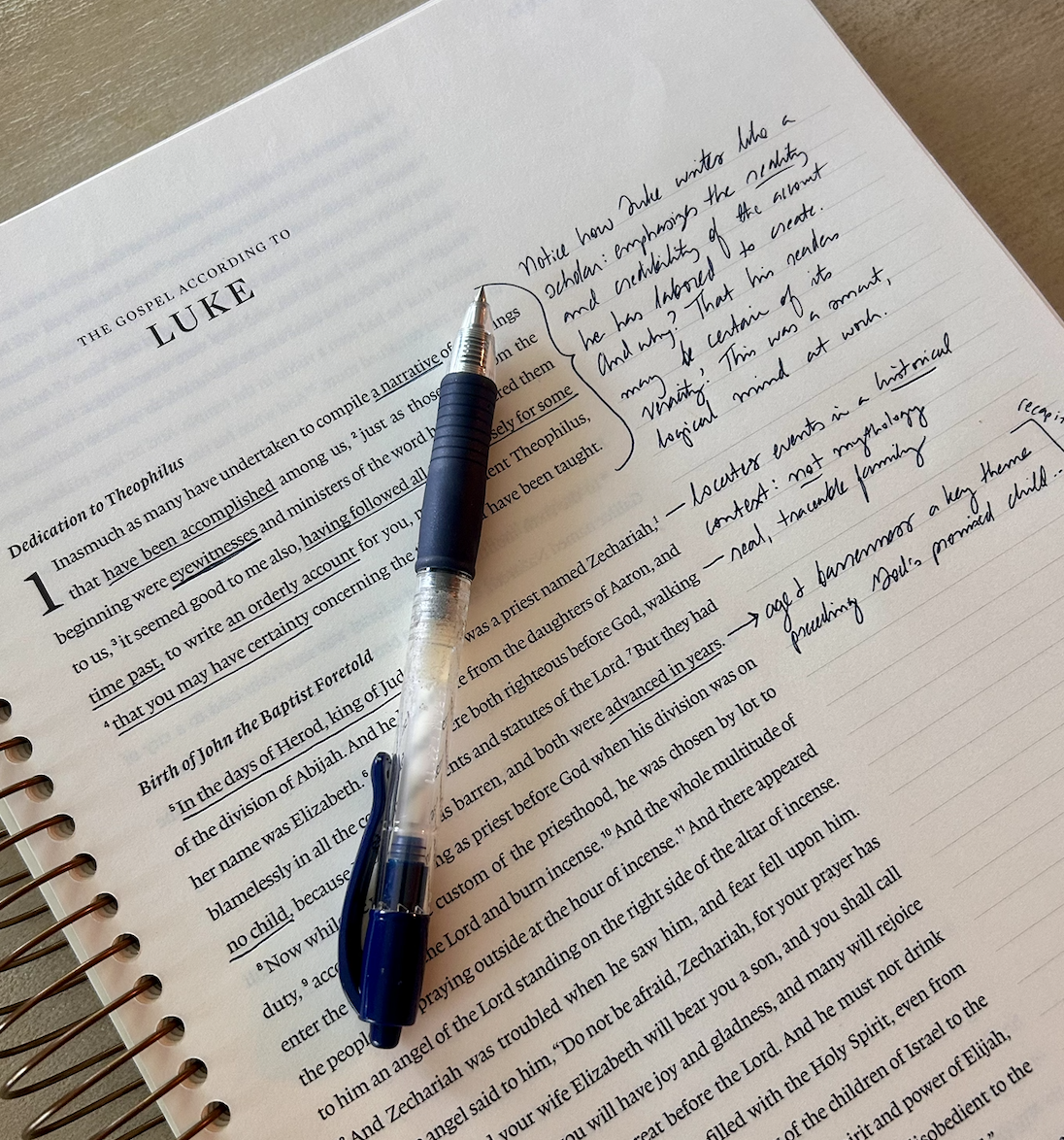
Thinking on Paper
I often do not know my own thoughts until they are sprawled out before me in my unpredictable cursive. As author and teacher William Zinsser says, “Writing is thinking on paper.”2 I am grateful for my new ESV Spiral-Bound Journaling Bible, which is making it easier for me to think on paper as I read God’s Word.
If you are interested in ordering a copy for yourself or a friend, you can do so using this Amazon link or by visiting Crossway’s website. Individual volumes including the Spiral-Bound Journaling New Testament are currently 50% off on Amazon, so be sure to check them out.
Note: Crossway sent me this Spiral-Bound Journaling New Testament in exchange for an honest review.
As a reminder, any purchases made using the Amazon links in this post help to cover the costs of maintaining my blog. You can also support my work by buying me a coffee using the button below:
- “10 Things You Should Know About the ESV Translation” https://www.crossway.org/articles/10-things-you-should-know-about-the-esv-translation/?gad_source=1&gad_campaignid=22446814493&gbraid=0AAAAADQBsDpCg6zlESdV-TMBR2HF-fEBh&gclid=Cj0KCQjwucDBBhDxARIsANqFdr2diHKJ7GY8NVy3Pfdv2D5JhW-tpdwaIMKYzACxwWo1UDndHK6w2FEaAmZmEALw_wcB ↩︎
- From William Zinsser’s On Writing Well. ↩︎


 Ryanne Molinari