On April 10th of this year, a helicopter crashed into the Hudson River, killing everyone on board: a family of five and the pilot. Within minutes, my weather app sent me a notification to alert me of the crash and invited me to “tap to stay informed.”
I am not a first responder. I have no intention of flying in a helicopter anytime soon. Oh, yeah, and I live in Iowa.
I downloaded the AccuWeather app for accurate weather forecasts—not minute-by-minute updates on far-off tragedies that have nothing to do with me and that I can do nothing about.
Why is my weather app trying to be a news source? Stay in your lane, AccuWeather.
And isn’t it a little weird that AccuWeather urged me to stay updated? As if it assumed that I would want to keep up with the unfolding drama of this fatal flight? As if by “tapping” my iPhone screen, I would somehow be involved—even helpful? Isn’t it concerning that this notification leapt immediately to the top of my notification banner as though it would be only natural for me to heed this news over and above a text from my husband, emails from church members, and actual weather alerts for my location?
This is the norm in our digital age. Unless we purposefully disconnect and proactively regulate our apps’ settings, we are forced to be aware of everything, everywhere, all the time.
But we were not made for such pseudo-omniscience and omnipresence. We are finite, embodied beings, made for particular places and in-person communities. No wonder anxiety and depression have skyrocketed since the introduction of the iPhone.
Aware of the negative impact of constant connectedness on my overall wellbeing, I’ve been working to distance myself from mindless digital use. In this day and age, it’s rare to find someone who isn’t. We all know that our digital engagement is disordered, but we may not know how to explain the root of the problem or correct it in a way that aligns with timeless Christian wisdom.
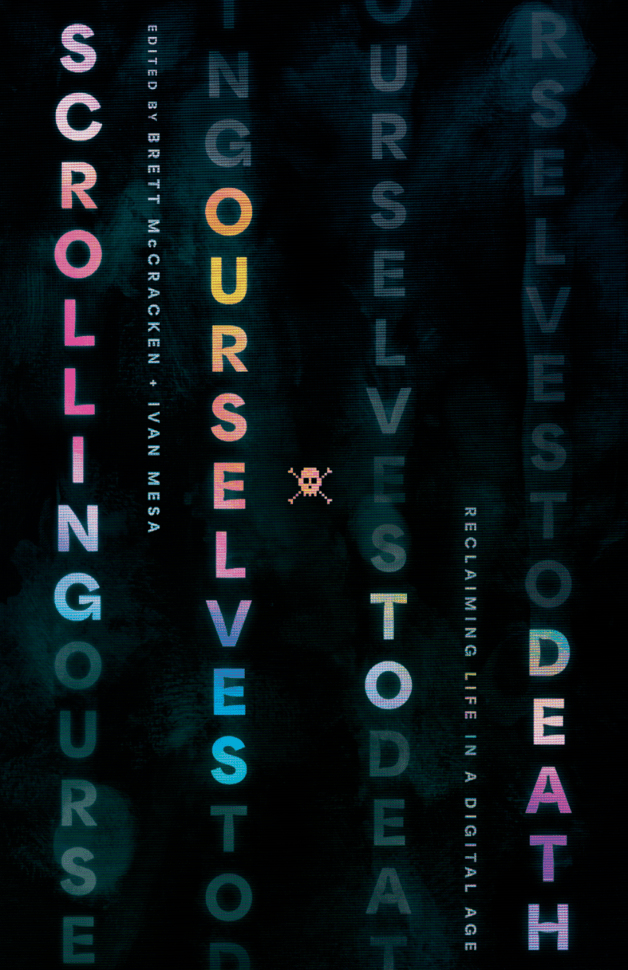
In Scrolling Ourselves to Death: Reclaiming Life in a Digital Age, various theologians and writers join forces to unpack the impact digital technology has had on individual users, society as a whole, and the Christian church. Arriving like a beacon of light amidst a barrage of notifications, this book brought clarity, encouragement, and insight to my digital engagement and I am eager to recommend it to other readers.
Authors & Topics
Scrolling Ourselves to Death: Reclaiming Life in a Digital Age is the joint effort of multiple theologians and authors, each of whom shares wisdom from his or her unique perspective about living in the digital era. Among these contributors are Collin Hansen, director of the Keller Center for Cultural Apologetics, Samuel James, author of Digital Liturgies: Rediscovering Christian Wisdom in an Online Age, and Read Mercer Schuchardt, professor of communications at Wheaton College. Scrolling Ourselves to Death is edited by Brett McCracken and Ivan Mesa, who serve as editors for The Gospel Coalition.
As one might guess from its multiple contributors—each with a particular background, vocation, and emphasis—Scrolling Ourselves to Death offers a wide-ranging conversation about life in the digital era. However, the unifying thread is the work and thought of the late philosopher Neil Postman (1931–2003).
Troubled by the impact of television on American individuals and society, Postman wrote Amusing Ourselves to Death in 1985. This book not only contained insight into the rise and consequences of television but has proven terrifyingly prophetic as the age of television has given way to the rise of something much more pervasive: digital media.
Drawing largely upon the ideas and observations put forth by Postman in Amusing Ourselves to Death, the writers of Scrolling Ourselves to Death aptly identify and discuss the dangers of our digital era—from dopamine addiction to the inability to follow a consistent thread of logic to unprecedented levels of mental health issues. The writers also draw on pivotal works of dystopian literature such as George Orwell’s 1984 and Adolph Huxley’s Brave New World to consider and critique our pleasure-addicted, soundbite society. (I would add eerily prescient Ray Bradbury’s Fahrenheit 451 to this list as something of a bridge between the other two novels.)
Scrolling Ourselves to Death is not merely meant to diagnose the problem of digital misuse and addiction and but to help Christians treat it. Even as the chapters expose the dire issues we face in the digital age, they offer biblical wisdom and hope. Many chapters include lists of practical ways to combat digital overuse and to reconnect with embodied community. The contributors consistently return to Christianity and the gospel as the only real hope we have of finding lasting stability and satisfaction in our shifting, increasingly synthetic world. Readers are repeatedly encouraged to prioritize in-person fellowship and worship, and to cultivate thoughtful disciplines that encourage self-reflection and rationality.
There are reflection/discussion questions at the end of each chapter, which help reinforce reading comprehension, as well as foster self-examination and interpersonal discussion. I highly recommend reading this book with a journal on hand so that you can jot down your responses and practice the art of reflection—which is itself a way of combating digitization! It would also be worth reading this book with a friend or two, as the questions are sure to inspire fruitful conversations. Plus, discussing this book with others in-person is yet another way to push back against digitization.
While I read Scrolling Ourselves to Death in its entirety, it could be read chapter-by-chapter. Readers could also select which chapters are most applicable to them and focus on those. Chapter topics include but are not limited to:
- A brief history of technological advancement
- Using technology wisely in ministry
- Prioritizing seasonal living in an age of “now”
- The effect of digital technology on memory
- Digital media’s destruction of logical thought and discourse
- How media types shape our messages
- How to live on mission in a digital world
I encourage you to check out the full table of contents and a sample chapter on Crossway’s website using this link.
A Few Stand-Out Quotes
On digital media as addictive:
“We’re amusing ourselves into addiction. Entertainment culture metastasized into something not even Postman could have predicted: dopamine media…The trade-off we all make in the digital era is not merely between substantive and trivial discourse. It’s between sobriety and addiction.” –Patrick Miller (p. 20)
On prioritizing in-person preaching and fellowship:
“Preaching to a camera might be more efficient for reaching a mass audience. And yet Paul never set target reach or engagement metrics for his protégé Timothy. The inefficiency of real people in an actual place at a specific time seems to help establish and confirm the legitimacy of our message.” –Collin Hansen (pp. 102–103).
On how sharing false or trivial things can harm our Christian witness:
“Given our truth-telling mission, Christians should be the most cautious about posting and reposting unsubstantiated, sensationalistic content and conspiracy theories. This becomes especially vital as AI technology increasingly blurs the lines between facts and fakery, the genuine and the generated, and the human and pseudo human. The presence of Christians on social media should add to the net amount of truth, goodness, and beauty while reducing the amount of nonsense in cyberspace.” –Thaddeus Williams (p. 127)
I am especially drawn to this third quote by Thaddeus Williams. Too often I see well-meaning and even mature Christians reposting AI-generated, sentimentalized images. Christians, we need to be discerning about what we share; sharing such rubbish obscures genuinely true and helpful content and makes us look foolish. (I suspect I’ll blog on this at greater length in the future.)
Who Should Read & How to Read
Scrolling Ourselves to Death is brilliantly written and many of its contributors are academics. However, it is accessible for all adult readers. It includes plenty of application tips and reflection questions to ensure that its ideas are not just theoretical but practical for everyday readers. It is sure to offer refreshment, understanding, and encouragement for all who are experiencing digital weariness.
I read this book over the course of two weeks, focusing on one chapter each day so as to better absorb its wisdom. This felt like an act of defiance against digital media, which is all about immediacy even if it means sacrificing comprehension and internalization.
As an aside, this is also why I opted to read a hard copy of this book rather than listen to it on audio or download it as a pdf. Indeed, this is why my husband and I keep squirreling away books in our basement library; we love the feel of paper, the satisfying thud of covers falling closed, and the ability to ink our thoughts in the margins. To read a physical book is to strike a small blow against the digital takeover; it distances us from the distraction of screens, fostering slowness and thoughtfulness. As Hans Madueme writes in chapter 4:
“The book medium invites readers into analytic, reflective, critical reasoning” (pp. 66–67).
I firmly believe this. I will admit, though, that I am partly trying to justify how beat-up my copy of Scrolling Ourselves to Death already is. (“I’m not a bad book owner! These stains and wrinkles show that I prioritize embodiment!”)
If Scrolling Ourselves to Death sounds interesting to you, I highly recommend ordering a physical copy or, at least, reading in such a way that you are not easily distracted. For example, if you are reading on a tablet, consider disconnecting from wifi so that you are not distracted by notifications or social media. Or, consider listening to the audiobook while jogging to help you stay focused and reconnect with your embodiment. If possible, I also encourage you to read Scrolling Ourselves to Death in community, whether this is one-on-one with a friend or in a more formal book club.
If Scrolling Ourselves to Death sounds interesting to you, you can purchase a copy on Amazon using this link or directly from Crossway using this one.
Note: I received a copy of Scrolling Ourselves to Death from Crossway in exchange for an honest review.


 Ryanne Molinari