You may have heard that Meryl Streep is in talks to potentially voice Aslan in Greta Gerwig’s new Narnia adaptation. At first I thought this was an April Fool’s joke, so I thought little of it. But when April 1st came and went without a “Gotcha!” my only reaction was grim resignation. I wish I could say I was surprised, but I never expected Netflix to honor Narnia, and such casting seems to be emblematic of Gerwig’s whole approach to the adaptation.
Having taken time to sort out my thoughts, I would like to pose few questions to Gerwig (not that she would ever stumble across my little blog). I would also like to conclude with word of advice for any who, like me, are struggling with indignation.
1. Do you like the story?
I don’t know about you, but I could never spend years (and millions of dollars) remaking a story I did not already love passionately.
I was eight years old when Andrew Adamson’s The Lion, the Witch, and the Wardrobe was released. Sharing a movie theater seat with one of my best friends, we watched it premier alongside members of our church. It was love at first sight. I’d already enjoyed the books, but this movie adaptation further captured my imagination.
When The Lion, the Witch, and the Wardrobe finally came out on DVD, I watched and rewatched it, reenacted it with friends and stuffed animals, and began writing my own spin-off in which I, too, become queen of a realm governed by a Great Lion. To this day, I cannot look at my vintage copies of the books or hear the soundtrack from the 2005 film without getting a little emotional.
That’s what makes me so sad about Gerwig potentially casting Meryl Streep as Aslan—or Aslanette? It makes me think that she does not really love Narnia—that maybe this, to her, is just an opportunity to earn money from an unnecessary remake and win applause for being subversive.
So that is my first question for Gerwig and all involved in the production of this project: Do you really love the story? Does your heart swell with affection for its characters? Its message? Its plot? Does the cry of “For Narnia! And for Aslan!” mean anything to you? Does the simple phrase, “Courage, dear heart,” bring you a comfort unspeakably sweet?
Do you love the story? Not the story as you think it should have been written. Not the story as our culture would write it today. The story as it is.
If not, then why not find some other story that you do love? A story that has not been told before on such a large scale? A story you do not have to change? Find that story and share it in its integrity.
2. Do you respect the author?
I was nervous to go see Gerwig’s 2019 adaptation of Little Women. Would she respectfully tell a story that celebrates the domestic and professional roles of women without denigrating one or the other?
To my relief, Gerwig did justice to the story of Little Women as it stands. Moreover, she went above and beyond earlier adaptations—much as I love them—by also honoring the author.
In her adaptation, Gerwig poignantly conveys the complexity of Jo March and, in this, pays tribute to her creator. Readers may not be aware that the author of Little Women, Louisa May Alcott, struggled with her decision to have Jo get married by the end of the book. Herself an unmarried writer, she resented the fact that books for women and children always had to end with matrimony. It was not that she scorned marriage and children—she was from a close-knit family and, upon her sister’s passing, adopted her niece—but she resented the idea that marriage and motherhood were the only acceptable ways to live as a woman.
Gerwig’s version manages to present both domesticity and professionalism as equally valid forms of womanhood. In this, she honors the plot and characters of the novel and the author’s personal experience and convictions. The end result is a masterful movie that preserves the March family we know and love and gives due honor to Louisa May Alcott.
My question for Gerwig now, then, is do you respect C.S. Lewis?
Do you accept that C.S. Lewis was a Christian theologian, writing an allegory according to his Christian theology? Or do you think he was misled and needs to be updated, purged of his backward ideas? Will you accept what Lewis was seeking to accomplish in the Narnia books and take up this charge in your own work? Or do you simply wish to pirate his plot, world, and characters and indenture them to your own ideological mission?
Do you respect Lewis and what he set to do through his writing? If not, why not find some other story by some other author whose values better align with yours?
3. Do you know your audience?
I never expected Gerwig or Netflix to protect the allegorical or theological integrity of Narnia. I did, however, expect them to pursue profit.
Ask anyone who they think reads or watches The Chronicles of Narnia most frequently and they will assuredly tell you: Christians.
Oh sure, other people enjoy Narnia and I am pretty sure that 95% of my Facebook feed is comprised of C.S. Lewis quotes, authentic and falsified, from Christians and non-Christians alike.
But when you cut to the heart of it, who is most likely to read and reread the Narnia books, and to stream a new adaptation of their familiar story? Who will be most ready to clamber back through the wardrobe?
Christians.
So changing the central character—the character meant to represent Jesus Christ? Probably not the best marketing tactic for reaching your primary audience.
Unless…the intended audience is not those who love Narnia but those who are eager for its downfall. Having read through a few discussions on Threads, it seems that the primary audience for Gerwig’s adaptation (intentionally or not) will be non-Christians who are ravenous to dismantle a Christian narrative—jeering as they tear it apart like the creatures surrounding the Stone Table.
Realistically, Gerwig’s intention does seem to be to rile up Christians and win points with those who hate them. But even so, I suspect this will affect her adaptation’s viewership and profit margin more than Netflix would like.
It’s also worth noting that, while priding herself on artistic innovation, Gerwig’s Narnia will likely end up joining the ever-growing list of remakes that force their originals to conform to the unorthodox orthodoxy of the day and fall flat while doing so. (Disney’s disastrous Snow White springs to mind. What do you mean fans of the original cartoon don’t want a creepy, preachy remake with a 21st-century stock heroine and a thief instead of a prince?)
Perhaps Gerwig will return to something resembling Lewis’s original tale with its original characters intact (pun unintended). Some commenters are suggesting that proposing Streep as Aslan is a test to see what (and how much) she can get away with. This may be so.
But for now, all I can think is that it is rather pathetic to work on a story you do not love by an author you do not respect for an audience you will not honor. If Gerwig wants to produce an anti-Narnia, why not remake Philip Pullman’s The Golden Compass? Then she could remain true to the story, respect its author, and reach her proper audience—all in one fell swoop.
Thoughts from The Last Battle
From what I’ve read, Gerwig is adapting the first Narnia book (chronologically) The Magician’s Nephew. If you haven’t read it or it’s been a while, The Magician’s Nephew is the Genesis of the Narnia series. In it, we hear Aslan singing the cosmos into being. We meet the first human parents of Narnia. We glimpse a garden, a tree, and a promise of life.
It’s a masterpiece. This book, along with Perelandra from Lewis’s Space Trilogy have lent tremendous depth to my reading of Genesis. Together, these books stretched out my imagination, preparing it to receive Scripture with fuller appreciation for its beautiful truth.
But it seems that the story Gerwig is actually producing—whether she knows it or not—is The Last Battle.
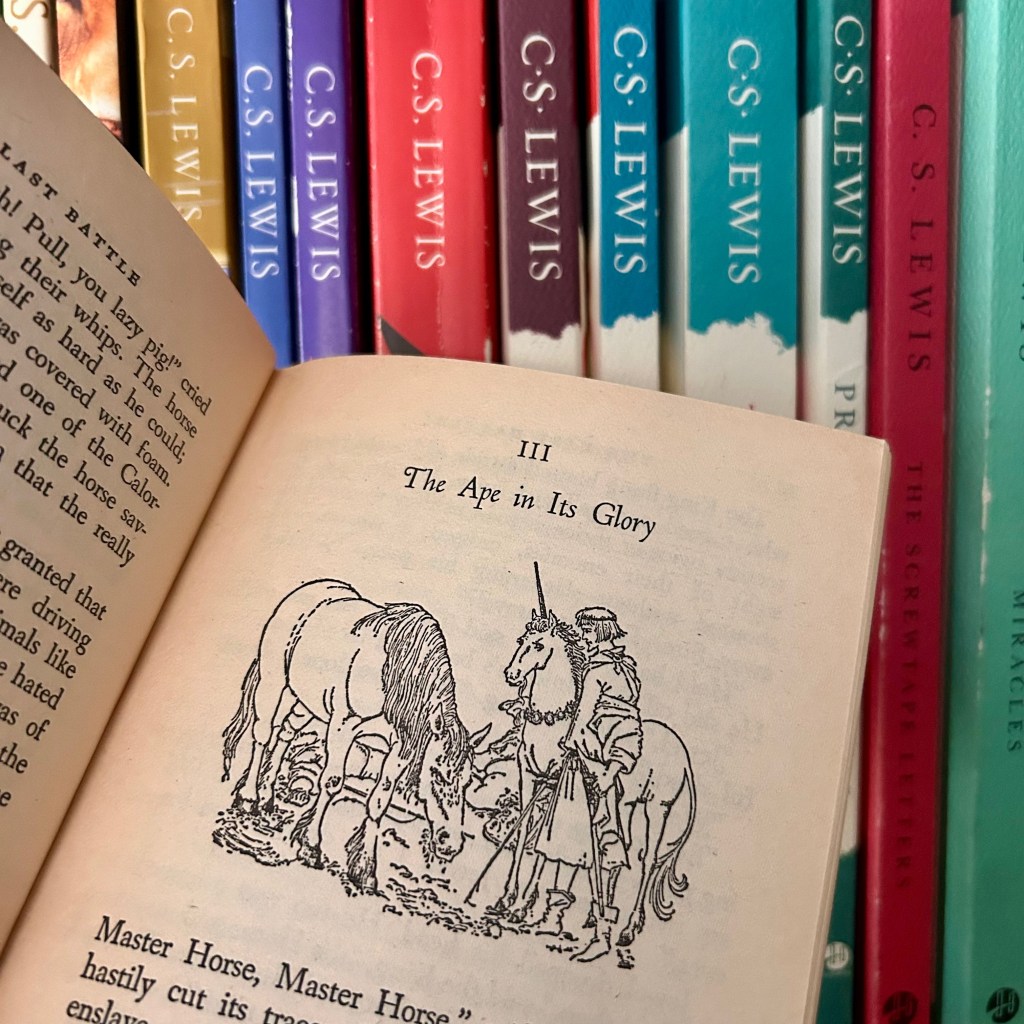
The Last Battle is Narnia’s Revelation. In it, we see an ape deceiving Narnia. He pretends to be a man and parades around a donkey in a lion’s skin, telling everyone that it is Aslan—he has returned!
It seems to me that this is the story we are watching unfold as Gerwig stands over a predictable postmodern trope and declares, “Behold, the Great Lion!”
But there is a magic deeper than Netflix knows. Whether Gerwig joins the White Witch in shaving Aslan’s mane or not, we can trust that all things will be put right again someday—in that story and in this one.
I’d like to leave you with a scene from The Last Battle that offers a necessary perspective to counterbalance the outrage I’ve seen swirling about online. (It’s a bit lengthy, but I encourage you to read it in full. It was balm to my indignant heart.)
Having captured the artificial Aslan, King Tirian prepares to kill him for his role in deceiving the country. Before he draws his sword, Jill, who also appears in The Magician’s Nephew, steps in:
“Oh don’t, please don’t,” said Jill. “Really, you mustn’t. It wasn’t his fault. It was all the Ape. He didn’t know any better. And he’s very sorry. He’s a nice donkey. His name’s Puzzle. And I’ve got my arms around his neck.”1
Tirian is aghast, but allows the donkey to speak for himself:
“Me, Sire?” came the donkey’s voice. “I’m sure I’m very sorry if I’ve done wrong. The Ape said Aslan wanted me to dress up like that. And I thought he’d know. I’m not clever like him. I only did what I was told. It wasn’t any fun for me living in that Stable. I don’t even know what’s been going on outside. He never let me out except for a minute or two at night. Some days they forgot to give me any water too.”2
Tirian relents and brings the donkey with him to meet an approaching crowd, declaring, “Let them see the thing they have feared and bowed to. We can show them the truth of the Ape’s vile plot.”3
At this, the donkey lifts his head and gives “a grand Haw-hee-haw-hee-hee; a thing the Ape hadn’t allowed him to do for days.”4
That joyful bray breaks my heart every time I read it, and it is a needed reminder to those of us who are indignant at what Gerwig and Netflix are doing to our beloved Narnia.
You see, the donkey does not know what he is doing. Indeed, he believes he is doing Aslan’s will. The Ape is using and abusing him.
Sound familiar?
Casting a woman as the Great Lion strikes many of us as a terrible transgression, but I have no doubt that those involved in this decision not only believe it is an artistically acceptable but highly moral. The ideologies of the day make it seem like the right thing to do.
While it is appropriate to be grieved when a beloved and beautiful story is perverted, we must not not forget that there is a deeper deception at play. It cannot undo the “Deep Magic,” but it is powerful nonetheless.
Gerwig might lift up an artificial Aslan but, like poor Puzzle, she knows not what she does. In an odd way, she is probably convinced that she is doing a virtuous and praiseworthy thing. She probably feels that she is liberating Narnia, making it more prosperous and postmodern—just like the Ape and the Calormenes do in The Last Battle even as they are ushering Narnia closer and closer to its end.
While we must not stop unmasking deception like the good King Tirian, we must also be like Jill, gently and fervently interceding on behalf of those held captive by the deceiver, who know not what they do.
Thank you so much for reading. If you enjoy my work and would like to help keep the words flowing, you can buy me a coffee using the button below:


2 responses to “On Netflix and Narnia: Three Questions and a Convicting Scene”
[…] On Netflix and Narnia: Three Questions and a Convicting Scene […]
LikeLike
[…] Sword fights, talking animals, delicious recipes—all taking place in a lovely woodland abbey? What’s not to love? Plus, this series goes on and on, providing a bounty of wholesome, courage-instilling stories for young readers. Apparently, there is soon to be a Netflix movie based on Redwall! (Let’s hope it’s more faithful than the upcoming Narnia Netflix series…) […]
LikeLike